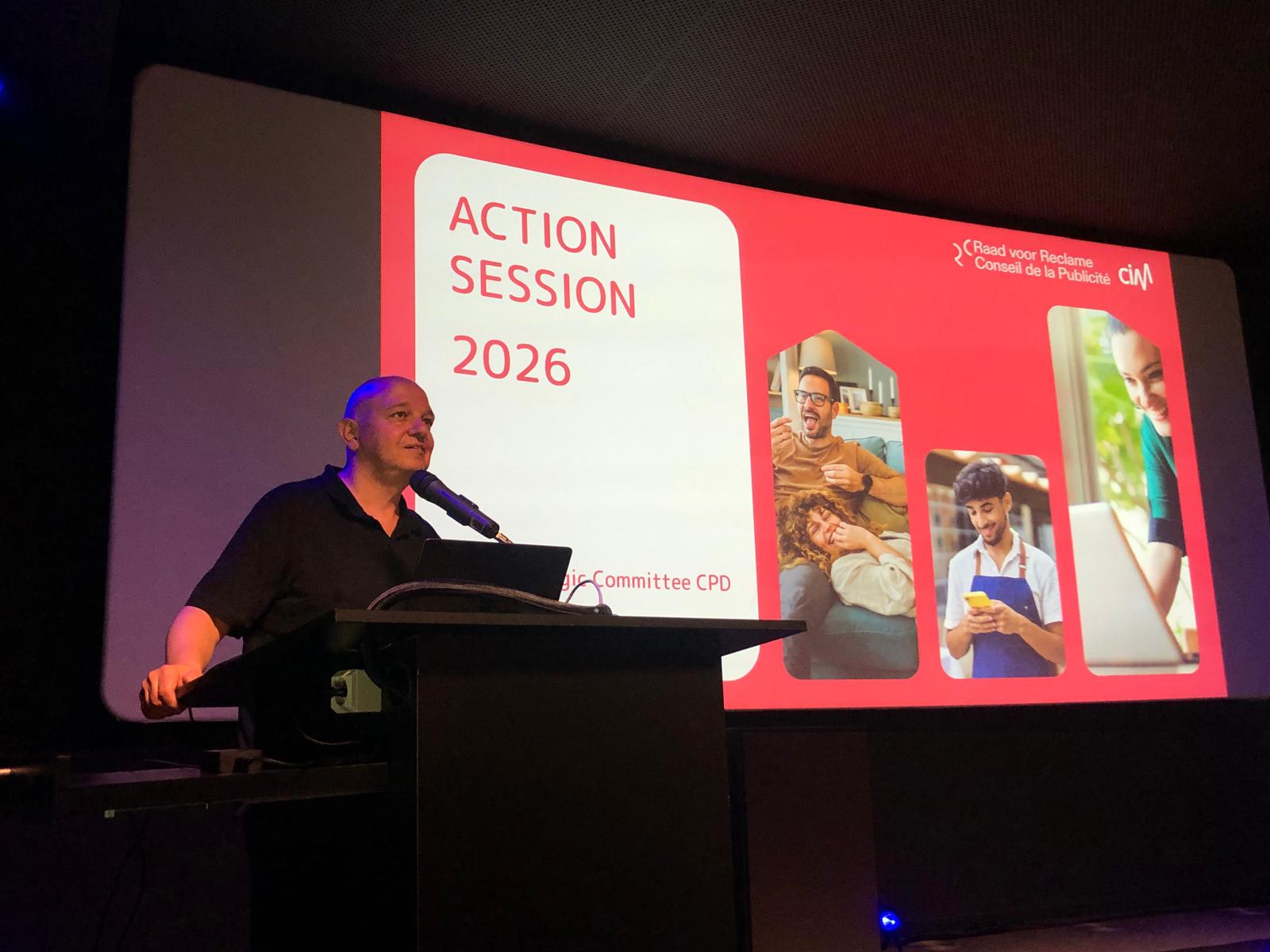
Media measurement is hot… That is the only conclusion one can draw after the second edition of the Action Session at RTL House, which put the spotlights on the new possibilities tecnhnology offers. We are not just talking about new opportunities in the field of media measurement, but also about marketing mix modelling, ad stacks and conversion measures. The fact that the event took place on what was (so far) the hottest day of the year, to wit Friday 26 June, undoubtedly played a part in this too…
1. Do not be deceived by paid search attribution
An econometric study by TAM Ireland (the Irish CIM) has shown that a great deal of web traffic generated by a TV or radio campaign only materialises later. Hence, attribution tools systematically underestimate the impact of TV and radio, and overestimate the impact of paid search. Jason Brownlee, Founder of Colourtext, who carried out the study, calls it the Google Tax.
2. MMM as an alternative to attribution
Chris Williams, Principal Consultant Data Engineering, also reached the conclusion that attribution overestimates the impact of digital media. He presented marketing mix modelling (MMM) as a better alternative. Particularly if we manage to make MMM faster and more practical by using similar tools on the sales and purchasing sides, such as Virtual Populations. The inclusion of geographical data (in stead of identity matching) could also lead to MMM getting better. When you slightly vary the media mix by geographical area (e.g. a media plan that is identical in every respect, with the exception of radio in a particular region), you can measure incrementality: how much additional turnover does that channel generate in that region, compared with a similar region without that deployment?
3. Clean rooms, conversion APIs and ID graphs enable cookieless closed-loop measurement
The National Lottery has long been recognised as a player that has raised the bar for measuring media impact and conversion in our country. Toon Diependaele, Digital Strategist at the National Lottery, provided an update on the subject, aided by data clean rooms, server-to-server conversion APIs, and ID graphs. These enable the advertiser to link mobile, CTV and desktop. Thus, he demonstrated that people who saw an ad – without third party cookies – were almost twice as likely to convert as those who had not seen an ad.
4. Advertisers focus too much on short-term performance and efficiency, whilst actually losing long-term value because of it
The research carried out by dentsu (in collaboration with Kantar and Lumen Research) into the relationship between short-term sales uplifts and long-term brand building contains a wealth of information. The key message is that brand building and performance marketing are not mutually exclusive, but should be planned together. Digital video, for example, can not only boost short-term sales, but also contribute to brand value for years to come. Hence, campaigns should not only be measured in the short term, but also in terms of their contribution to long-term sales and brand value. Advertisers are therefore best advised to ply a ‘total video’ strategy in which linear TV, CTV, online video and social video are used in a complementary manner.
5. 20” is better than 30”
Second takeaway from The Brand Reset: the eyetracking study reveals that the consumer has an ‘ideal’ attention span. This amounts to 20”. Therefore, the classic 30” spot is a bit too long, which prompts the initiators to challenge creative agencies to produce shorter spots and, thus, get the message across in less time.
6. Voluntary attention is better than forced attention
It very probably is not the the most surprising conclusion, but the above dentsu study shows that skippable ads generate more impact than adverts that the consumer is forced to watch before being able to view any content. Reynder Bruyns: ‘Feel free to go for skippable formats, provided the creative is strong enough to deserve voluntary attention.’
7. New format standard makes cross-device measurement easier
Valérie Janssens (Director Media, Data & Tech at RMB) presented a new standard to integrate ads in streaming platforms: SGAI or Server-Guided Ad Insertion. This technology is used by streaming services such as Disney+, Netflix and Amazon Prime, and enables you to develop rich, interactive creatives within a stable, ad-block-free experience. Until recently, that was impossible.
8. We are moving to more ‘conversational experiences’
Dimitris Beis, Data & Innovation Strategist at IAB Europe, gave an update on agentic AI and its impact on the advertising market and adtech. His conclusion? That we are moving to more ‘conversational experiences’ of the consumer, and that this trend will call for a new way of advertising. He added that it will not be about new features, but about a new way of communicating between the brand and the consumer. In other words: kind of a system change…
9. AI makes Ad Managers better
In recent years, technology has made it possible to schedule campaigns personally via Ad Managers. AI adds a new layer to that, Toon Coppens (Director Advertising Data & AI at DPG Media BeNe) explained. In DPG Media’s Ad Manager, Smart Assistant automatically identifies the most relevant audiences from the hundreds of available bundles, based on a briefing. Smart Studio does the same for creatives: text, image and animated versions of a single banner or text are automatically generated, along with format conversions (e.g. social video to vertical or CTV formats). This is particularly valuable for medium-sized and long-tail advertisers who do not have the resources themselves to produce individual creatives for each format.
Incidentally, DPG Media has provided a number of APIs that can be linked to Ad Manager. This makes it possible, amongst other things, to establish the link with traffic at the point of sale.
10. Thanks to AI, contextual targeting no longer needs a personal touch
Until now, contextual targeting via a DMP has always been set up by people. As a result, each targeting inevitably took on a personal slant, based on an individual’s own experiences and assumptions. Indeed, it was difficult to leave context entirely to algorithms and technology. According to Raphaël Stuyck, Senior Consultant Adtech & Data at IPM, this problem is solved by AI. By linking an LLM to the DMP via an MCP, you can eliminate that human interpretation.
11. Publishers might well be able to make money from LLMs
Publishers see LLMs as a major threat. Indeed, the latter scrape the internet and thereby take over content from publishers, often without any source citation or link. However, according to Birger Soiland, Head of Publisher Partnerships at Tollbit, it is technically and commercially feasible to charge for AI access to content rather than opening up the content. To this end, he proposes notifying AI companies when new content is published, rather than allowing them to continuously scrape websites. After all, this saves a great deal of AI capacity (and therefore costs). What is more, when the technical infrastructure is shared and industry initiatives such as IAB Tech and Sphere Coalition emerge, publishers can join forces and negotiate with a unified voice.
Recent news


CIM ONE: “Belgium is once again becoming a global player in media measurement” - Luc Suykens (interview UBA)
Belgium is back on the global map of media measurement. With CIM One, the tripartite body…

BPX and XMC map audience attention to adverts
In addition to reach figures, insights into attention to advertisements provide important…
Recent news


CIM ONE: Transition to consumer-centric measurement – article The Media Leader 08/05/2026